Friday, 5 June 2026
The Saint: The Set-Up, The Abductors, The Death Penalty
It should be pointed out that The Saint and Mr Teal belongs to the first phase of the Saint’s adventures and features the first version of the character. At this stage Simon Templar still has a lot of the overgrown hyper-active schoolboy about him, with a schoolboy sense of humour and an extraordinary recklessness. The character evolved over the years, in a believable and logical manner. The Saint grew up. He became older and wiser, with a slight sense of wistfulness and while he never lost his taste for adventure it was tempered with good judgment. The Saint, as he grew older, also became more of a genuinely sophisticated man of the world, and a restless world-traveller. The character in the TV series is based on this final version of Simon Templar.
This necessitated a few changes when these stories were adapted for TV.
The Death Penalty
The Death Penalty was the ninth episode in the third season of The Saint. It was scripted by Ian Stuart Black and went to air in December 1964.
The big problem facing anyone trying to adapt the Saint stories for television in the 60s was that the stories had to be sanitised. Most crucially Simon Templar as a character had to be sanitised. He had to be sanitised a lot. In Charteris’s stories the Saint is an unrepentant criminal. He has ethics. He only steals from bad people. But he is a thief and feels no shame about it. The Saint is also extremely ruthless. If he thinks that a man really needs killing then he’ll kill him without feeling the slightest remorse. The Saint is one of the good guys, he’s on the side of justice, he is a sworn enemy to those he refers to as the ungodly but he also feels very strongly that sometimes the most effective solution to dealing with the ungodly is simply to kill them.
For television all of these elements had to be not merely toned down, they had to be eliminated. Unfortunately these elements were what gave Charteris’ stories their unique flavour. Simon Templar had to become a Boy Scout, which meant that he ceased to be Simon Templar. That the TV series worked so well was due largely to the charm and charisma of Roger Moore. I love the TV series, but it lacks the bite of the books.
The Death Penalty was a story that presented a very big problem. In this novella the Saint displays a breathtaking disregard for the law and sets out to commit coldblooded murder.
The basic plot outline is retained. There’s a power struggle between two crime lords, Stride and Osman. Stride’s daughter Laura becomes an element in that struggle. There’s an Englishman working as secretary to Osman and he’s a mere shell of a man. Simon is determined to save Laura. There’s a climax on Osman’s yacht which ends in murder.
It’s an OK story but all the elements that added spice to Charteris’s story have been removed. In the novella Stride sells his stepdaughter to Osman to save his own skin. He is as rotten and corrupt and evil as Osman. In the TV episode Stride would never do such a wicked thing. He’s a criminal but a devoted father. In the novella Simon’s intention is to carry out coldblooded murder. In the TV episode Simon would never do anything so ruthless. He hopes to leave justice to the police. The secretary Clements is just a drunkard in the TV adaptation rather than a man who has been systematically stripped of his self-respect.
The TV episode is enjoyable enough but it lacks some of the edge of the original story. The novella is like a double Scotch with a dash of soda. TV episode is like a Scotch and soda with extra soda and no Scotch.
The Set-Up
The Set-Up, scripted by Paddy Manning O’Brine, went to air in January 1965 and was based on Charteris’s novella The Man from St Louis.
Again the basic plotline is fairly similar. An American gangster with ruthless American methods has been behind a string of daring robberies. He has a gang of would-be tough guy English crooks. Simon has decided that this sort of thing cannot be allowed to happen in England and as in the novella he’s prepared to assist Chief Inspector Teal.
Simon utilises the same ploy he utilises in the novella when Ted comes gunning for him. As in the novella Tex suspects that someone in his organisation has squealed.
The thieves are more up-market than in the novella and a female movie star is introduced into the story to add some glamour but these minor changes are very much in keeping with the feel of the TV series.
The climactic heist sequence is original to the TV script and it’s well executed. The ending is satisfactory although it lacks the twisted cleverness of the ending of the novella.
The Abductors
The Abductors, scripted by Brian Degas, went to air in July 1965 and was based on Charteris’s novella The Gold Standard.
Once again the bare bones of the original story are retained. A man is murdered in Paris and the murder is connected to a plan to kidnap his brother, a top metallurgist. Again there’s a sinister Mr Jones involved. And as in Charteris’s story Simon Templar was on the spot when the murder occurred.
Patricia Holm does not appear in the TV series at any stage (this is the later incarnation of the Saint as a loner) so as in several other episodes a female guest star is introduced to fulfil the same plot function - to lead Simon to the bad guys’ lair. In this case the guest star is the charming Annette Andre who would be a regular in a later ITC series, Randall and Hopkirk (Deceased). The Saint will have to rescue both the girl and the professor. It was presumably felt that one of the key plot points in the novella would have been too outlandish so it’s dropped and the reason for the villain’s interest in the professor is left rather vague.
And again the essential bite of the original story is missing.
All three episodes are quite good and reasonably enjoyable but none of them are up to the standards of Charteris’s stories. One can’t really blame the screenwriters. They had to make the stories more wholesome so as not to corrupt the fragile morals of British TV viewers and that’s what they did. Unfortunately in all three cases it meant that Charteris’s deliciously clever devious endings had to be sacrificed and replaced by utterly boring utterly conventional endings. It’s no wonder that this TV series reduced Leslie Charteris to despair.
I’ve reviewed the original novella collection The Saint and Mr Teal at Vintage Pop Fictions.
Friday, 27 March 2026
The Prisoner TV tie-in novel
The first of the novels is The Prisoner (later reissued as I Am Not a Number!) which was written by Thomas M. Disch. Disch was a prominent figure in American New Wave science fiction in the 60s. Given that The Prisoner has a very slight science fictional flavour and that New Wave SF tended to be paranoid and edgy Disch was perhaps a fairly appropriate writer for the assignment.
A man and a woman are having dinner in a restaurant. The relationship between them is not entirely clear but there’s some heavy flirting going on. The man has just quit his job. The woman is surprised that he was allowed to do so. He has bought himself a little cottage, a converted gatehouse, in Pembroke in Wales. He has only seen photographs of the cottage but he is sure it will suit him. He has spent the day looking at the furniture he would love to buy for his new home but it’s all hopelessly out of his price range. He will have to be content with cheaper more utilitarian furnishings.
He boards the train for Pembroke. A taxi takes him to a village which is disturbing in its excessive attempts at cuteness and cosiness. He had never been here before but it seems oddly but subtly familiar. He spots his cottage. It looks just as it did in the photos. He attaches no significance to the number 6 on the door. He is puzzled to find that all his furniture is there - the furniture he had fantasised about buying. The furniture that nobody had known that he desired.
He quickly discovers that he is a prisoner. Everybody in the Village is either a prisoner or a jailer but there is no telling which are which. Everybody is referred to by a number. He is Number 6. The person in charge is Number 2.
So it begins exactly as does the TV series, except that it’s not quite the same. There’s that slight feeling that he’s been here before. If you’re familiar with the TV series you will know what’s going on, except for Number 6’s feeling of déjà vu. There’s something else going on here. And Number 6 has some strange gaps in his memory.Of course if you know the TV series you know that Number 6 is a British secret agent who has quit the Secret Service. Disch obviously assumes that you do know the TV series and that you do know this but oddly (and I assume deliberately) the words spy or secret agent are never mentioned. Perhaps it’s those gaps in Number 6’s memory. He is obviously aware that he had worked for the government in some capacity connected with security or intelligence but perhaps he no longer remembers exactly what his job had been. Perhaps he no longer possesses the information that Number 2 wants.
When writing a TV tie-in novel it is essential to do nothing to undermine the premise of the TV series. Disch obeys this rule. There is nothing in the novel that is in any way in conflict with the TV series. It’s clearly the same Village. Number 6 is clearly the same Number 6. The themes of the novel are all present in the TV series. This is not a reboot or a re-imagining, but nor is it merely a retelling of the same story.
Disch has added nothing but has put slightly slightly more emphasis on aspects present or implicit in the series. Memory and identity become extremely important. Number 6 is desperately trying to cling to his sense of identity but if one loses parts of one’s memory one’s identity is in a sense threatened. That’s the case not just with Number 6 but with Number 41. She is the woman with whom he was having dinner at the beginning of the novel. Or she might be. Her name is really Liora. Or it might be. It might also be Lorna. How does she come to be in the Village? Is she a prisoner or a jailer? Can Number 6 trust her? Are any of the things she has told him true? And can she trust Number 6?
The paranoia goes deeper. There are things that are genuinely puzzling to Number 2. There are things about Number 6 that are not in line with Number 2’s expectations. And Number 2 also does not know whom he can trust. Even worse, he’s not sure if Number 1 trusts him.
So Disch amps up the paranoia and the sense of an intricate web of lies and deceptions, and the threat to identity. All of which are of course part and parcel of being a spy. And Disch handles these aspects with great skill.
And then Number 6 is persuaded to mount a production of Shakespeare’s Measure for Measure, after which things get seriously weird.
I’m not sure this novel could really be considered as strictly belonging to The Prisoner canon but it’s an interesting riff on the same theme and a wild crazy science fiction spy thriller. Highly recommended.
I’ve also reviewed The Prisoner (1967-68) TV series.
Sunday, 22 December 2024
The Girl from U.N.C.L.E. - The Blazing Affair
These TV tie-in novels were sometimes written before the series in question had even begun its run and were based on the original concept of the series and perhaps the first couple of scripts. As a result they sometimes have a tone that differs slightly from that of the TV series. I suspect that might be the case here. This book and Avallone’s earlier The Birds of a Feather Affair have a more serious and much less outrageous tone than the series.
The Blazing Affair makes use of one of the most overused tropes of 1960s spy fiction and spy television - someone is trying to revive the Third Reich.
It begins with an attempted assassination in the Balkans but the action then moves to South Africa. Diamonds seem to be involved. Presumably these will be used to finance this latest attempt at world domination. A lot of western agents have disappeared in this country in recent times, suggesting not only that South Africa may be the epicentre of this latest threat to world peace but also that the people involved in this conspiracy are exceptionally ruthless and well-organised.
The finger of suspicion points towards a diamond dealer, Simon Ashley.
Crack U.N.C.L.E. agents April Dancer and Mark Slate are sent to South Africa to investigate. Unfortunately their covers are blown and things get unpleasant. Being chased by guys with machetes, that sort of thing.
As you’d expect April and Mark both get captured by the bad guys and end up in some situations that are both dangerous and creepy.
There’s some reasonable suspense. There’s quite a bit of action and a few explosions along the way.
There’s lots of gadgetry. April is a walking arsenal. Even when she’s stripped down to bra and panties you can’t be sure she’s unarmed.
All the right ingredients are here and the plot is serviceable enough but it just doesn’t quite catch fire the way it should. Perhaps the problem is that the villains needed to be a bit more colourful, and perhaps it needed a more fully thought-out plan for world domination in order to give the story a greater sense of threat and urgency.
One of the things I love about the TV series is the chemistry between Stefanie Powers as April and Noel Harrison as Mark, with lots of cheeky affectionate banter. There is some of that in the novel, but not to the same degree.
More could have been made of the South African setting, and the diamond angle.
It’s all fairly chaste, even when April is half-naked. That is of course true of the TV series as well but spicing things up just a little in the novel wouldn’t have hurt.
On the whole it’s a competent enough spy thriller and reasonably enjoyable. Worth checking out if you’re a fan of the TV series.
I’ve also reviewed several other Girl from U.N.C.L.E. original novels - Michael Avallone’s The Birds of a Feather Affair (which is quite good) and Simon Latter’s The Global Globules Affair and The Golden Boats of Taradata Affair (both of which are fun and more lighthearted and with a bit more craziness).
And I’ve reviewed the Girl from U.N.C.L.E. TV series.
Sunday, 26 May 2024
The Girl from U.N.C.L.E. - The Cornish Pixie Affair
I’m rather fond of TV tie-in novels, especially the ones that are original stories rather than novelisations of TV episodes. They often have a subtly different tone compared to the TV series. They’re often darker and more violent, and sometimes sexier. The Girl from U.N.C.L.E. novels are definitely slightly more serious than the TV series. In fact the first of the novels, Michael Avallone’s The Birds of a Feather Affair, is very dark indeed.
Another fascinating feature of TV tie-in novels is that they often make explicit things that are only implied in the series. In some cases these are things that would not have been acceptable to the TV networks. In the case of The Cornish Pixie Affair we’re explicitly told that U.N.C.L.E. is politically strictly neutral, favouring neither the western powers nor the eastern bloc. That’s implied at times in the TV show but never explicitly stated.
Peter Leslie (1922-2007) was a reasonably prolific author who wrote quite a few TV tie-in novels based on various TV series including several The Man from U.N.C.L.E., Danger Man, The Invaders and The Avengers.
The Cornish Pixie Affair starts with a murder in a circus, always a good way to start a mystery or thriller story. The murder takes place in rural Cornwall. Sheila Duncan ran a concession stand in a travelling circus. She sold souvenirs. The murder might have been the result of a complicated romantic entanglement but what worries Mark Slate is that Sheila may have been murdered because she was a secret agent. She was in fact an U.N.C.L.E. agent and she was working on a case.
Ace U.N.C.L.E. agent April Dancer is sent to Cornwall to take charge. She talks her way into a job in the circus, taking over Sheila Duncan’s concession stall. There are clues but they seem to make things less clear. Why do so many people want to buy cheap black porphyry statuettes of Cornish pixies? Such statuettes don’t appear to exist, but people keep asking for them. And why are the little souvenir lighthouses made in such an odd way?
And what could possibly be the motive for the second murder?
April decides that engaging in some flirtation with one of the suspects might pay dividends, but she finds out that harmless flirtation can get a girl into a lot of trouble. A girl can end up chained in a dank cellar.
This is a perfectly competent spy thriller. The plot is not exactly dazzling but it’s serviceable.
April and Mark behave in ways that are generally consistent with what we know about them from the TV series (which is essential if you’re going to write a TV tie-in novel) although the novel would have benefited from a bit more witty banter between them.
April gets to make use of plenty of gadgets. It’s amazing what can be done with the things women carry around in their handbags. Or at least the the things April carries around in her handbag.
It’s all fairly straightforward with very little in the way of outlandishness. That’s a good thing and a bad thing. The books lacks the silliness that marred so many of the TV episodes but it lacks the subtle touches of the outrageous that made the good episodes so enjoyable. The circus setting is used quite well.
There’s a reasonable amount of action and suspense. It picks up steam in a major way towards the end with quite a bit of mayhem and some tense race-against-time stuff.
Overall it’s a book that fans of the series should enjoy. Recommended.
I’ve reviewed three of the other Girl from U.N.C.L.E. novels - Michael Avallone’s The Birds of a Feather Affair, Simon Latter’s The Global Globules Affair (which is great fun) and The Golden Boats of Taradata Affair (also by Simon Latter).
Thursday, 25 January 2024
The Avengers - Stay Tuned
Steed is getting ready to leave for three weeks holiday. As he’s about to walk out the door Tara arrives and she’s decidedly puzzled. Steed has already had his three-week holiday. Steed assumes that she’s playing a joke on him, until she advises him to check his suitcase. It’s full of dirty laundry and souvenirs he bought on his vacation. She also shows him today’s newspaper, whereupon Steed realises he has lost three weeks of his life.
He must have been somewhere during those three weeks but he has no idea where. He doesn’t remember a thing.
He also tries to crash Tara’s car, but he doesn’t know why.
The forensics people check his car. It has been in France and Italy, and it has recently been sideswiped by another vehicle.
And then Steed finds himself once again getting ready to set off on that very same holiday. Losing his memory is bad enough but he seems to be condemned to keep living the same events over and over again.
To solve the problem he will have to figure out why Tara lied to him. She would never lie to him. It doesn’t make sense.
Even when we start to realise at least some of what is going there’s still plenty of suspense and weirdness. Steed of course fears that he is going mad, and it has to be admitted that the evidence tends to point that way. Tara on the other hand refuses to believe that Steed has gone mad. One way or another she’s going to find the solution to the puzzle, or at least help Steed to do so.
A nice touch is Tara’s very genuine concern for Steed, which is clearly more than just professional concern.
Mother doesn’t appear in the early part of this episode. He’s on leave, so Father has taken over. Father is of course a woman, and both Father and Father’s flat add further surreal touches. And Mother will put in an appearance later - he has an important part to play in the plot.
Both Patrick Macnee and Linda Thorson are in fine acting form. Roger Delgado provides a menacing and sinister presence.
And we get a good fight scene between Linda Thorson and Kate O’Mara. Honestly, what more could you want?
The bizarre psychiatrist’s office set, the mysterious room in the house in Fitzherbert Street and the man following Steed and Steed’s totally unaccountable failure to spot this man even when he’s only a few feet away from him add further bizarre disturbing touches.
The set design is top-notch. There’s a wonderful atmosphere - there’s something very wrong and unsettling about everything but Steed just can’t put the pieces together.
Stay Tuned is yet another Tara King episode that compares more than favourably the best Emma Peel episodes. Highly recommended.
Sunday, 3 December 2023
The Saint in colour, part 2
Locate and Destroy
Locate and Destroy (scripted by John Stanton and directed by Leslie Norman) went to air in December 1966.
Locate and Destroy begins with what seems to be an attempted hold-up in an art dealer’s shop in Lima, Peru. Simon Templar naturally just happens to be on hand and foils the robbery. Except that it wasn’t a robbery. This much is obvious to the Saint. He decides that he’d like to find out what was really going on. The fact that it’s none of his business is merely an added attraction. In fact what is really going on is a bit too obvious from the start, and the story relies on too many clumsy clichéd narrow escapes.
This one is a bit disappointing. It’s not terrible, it’s just very average.
The Better Mouse Trap
The Better Mouse Trap (scripted by Leigh Vance and directed by Gordon Flemyng) screened in November 1966.
The Saint is in Cannes and of course crime has followed him there, in the shape of a series of daring jewel robberies. Naturally the police assume Simon is the thief. They always do.
As often happens in Simon’s adventures the woman is somewhat ambiguous. The viewer certainly has plenty of reason to suspect that she’s mixed up in the robberies.
This is very much a stock-standard Saint episode, enlivened by a comic turn by Ronnie Barker as a bumbling French policeman. There’s the usual stock footage to convince us we’re in the south of France.
Nothing special, but it’s executed competently.
Little Girl Lost
Little Girl Lost (scripted by Leigh Vance and directed by Roy Ward Baker) went to air in December 1966.
Simon is in Ireland where he rescues a young woman from a couple of thugs. The woman claims to be Hitler’s daughter! Simon is sure she’s either mad or lying but he likes a good story and she is pretty and it all sounds like it could be an amusing adventure.
There’s a millionaire mixed up in it and a couple of crooked private detectives, Simon and the girl get chased through the countryside and there’s young love thwarted and a matter of a hundred thousand pounds. And quite a bit of fisticuffs.
All in all this is a delightful light-hearted romp.
Paper Chase
Paper Chase (directed by Leslie Norman and written by Harry W. Junkin and Michael Cramoy) went to air in December 1966.
A chap named Redmond from the Foreign Office has defected to East Germany taking with him a vital file. Simon gets inveigled into working temporarily for British intelligence since he can identify the defector. But it’s not as simple as that. The East German spy who was Redmond’s contact wasn’t what he seemed to be. And Redmond finds he’s been conned.
There’s also a pretty girl (naturally). She’d like to go to London with Redmond. Or with Simon. Or with anybody who’ll take her.
This story gives Roger Moore a chance to do the James Bond thing which of course he does pretty well. There’s a lot more action than usual and some decent suspense.
All in all this is a pretty good spy thriller episode.
Flight Plan
Flight Plan (directed by Roy Ward Baker and scripted by Alfred Shaughnessy) went to air in December 1966.
Diana Gregory (Fiona Lewis) arrives in London to meet her brother Mike but a phoney nun tries to kidnap her. Luckily when a damsel is in distress you can be sure that Simon Templar will be at hand to rescue her. But then there’s another mystery - her brother, an R.A.F. pilot, is nowhere to be found.
Mike had been one of the pilots testing the new top-secret British fighter the Osprey (which appears to be the supersonic version of the Harrier that was planned at one stage) and it doesn’t take Simon long to figure out that there’s some kind of plot afoot involving that aircraft. Mike turns out to be a bit of a loose cannon, being a drunkard who passes bad cheques. Just the sort of person who get mixed up in an espionage plot.
This is a decent spy thriller episode with the added bonus of aerial adventure (although the aerial stuff is of course almost entirely stock footage). William Gaunt (from The Champions) plays Mike.
Final Thoughts
Five episodes, two of them a bit on the routine side but three of them very good.
Tuesday, 31 October 2023
Callan Uncovered
The first of the stories (a Christmas assassination tale) was written for TV Times in 1967, shortly after David Callan made his screen debut in A Magnum for Schneider and at about the time that the first season of Callan started airing. The other twenty-four short stories appeared in the Sunday Express over the next few years.
Callan was a spy series that was character rather than plot-driven. The focus was on the psychology of British government assassin David Callan, a killer who no longer enjoyed killing. There’s also an emphasis on the fact that Callan’s victims are not just targets. They are real people. They have wives, and daughters. They have the normal human hopes and fears. In order to carry out his assignments Callan has to get close to his victims which makes it impossible not to see them as real people.
The problem with these stories is that they were written for newspaper publication and they therefore are fairly short short stories with not a lot of scope for characterisation. In fact some of the stories are really just vignettes. They’re mood pieces. They do however manage to capture the cynical seedy paranoid atmosphere of the series.
I’m assuming that these stories are reprinted in roughly the order in which they were written. I suspect that this is so because the quality of the stories gradually improves. It seems as if Mitchell took a while to get a handle on the very short story format. The first half dozen stories are pretty then but after that Mitchell really hits his stride and gives us some very punchy, twisted, dark and cynical tales.
In fact the mood is more cynical than the TV series. The whole point of the TV series is that in the Cold War the good guys weren’t much better than the bad guys. In these stories it’s hard not to see the British intelligence services as out-and-out bad guys. This is the British government not just assassinating foreign agents but brutally murdering British citizens who are often quite innocent merely because their existence is potentially inconvenient to the government. It’s pretty chilling stuff. Hunter is sinister and creepy enough in the TV series but in some of these stories he is clearly evil, and it’s the worst sort of evil, the evil that cloaks itself in high principles which in reality are nothing more than expediency.
Mitchell takes the opportunity to do the occasional quirky story which would not have worked on TV. A story like File on a Careful Cowboy would have come across as slightly surreal on TV and that’s not consistent with the overall tone of the series.
The Stories
In File on a Deadly Deadshot six men enjoying a weekend of shooting. One is the intended target of an assassin. One of the others is the assassin, and Callan has to find out which one. There’s a bit of an attempt in this story to flesh out the Callan-Hunter relationship.
In File on an Angry Artist Callan gets a surveillance job. A struggling artist with a major anger problem may be in possession of top-secret documents.
In File on a Reckless Rider it seems like members of a fox hunt are being targeted but maybe there’s more to it.
File on a Weeping Widow is better developed than most of these stories. The widow of a racing car driver is suspected of espionage but the suspicions are very vague. It’s enough to get her a Red File, but Hunter is prepared to be convinced that she’s clean. Callan’s job is to find evidence to clear her. Callan gets personally involved, in fact he falls in love with the woman. Hunter isn’t totally heartless. If she turns out to be a spy he won’t ask Callan to kill her. He’ll get Meres to do it instead.
File on an Angry Actor presents Callan with a rather unusual assignment. It’s not often that the Section’s target for assassination is a famous movie star. Callan gets a job working on the star’s latest movie and Lonely gets work as an extra.
File on a Lucky Lady is the most successful of the stories so far. Callan has to keep a rich girl alive and unharmed. Hunter fears she may be kidnapped in order to put pressure on here fabulously wealthy father. There’s a bit more action and excitement in this story.
File on a Dancing Decoy introduces Callan to the world of ballet. A Russian ballerina defected a while back but why was it so easy for her? Is she being used?
The diary concerned in File on a Deadly Diary was kept by the late husband of Lady Black. Diaries of important people are always likely to prove embarrassing to someone. In this case there are lots of nasty people who want the diary. Some want to publish it. Some want to suppress it. Including some unexpected interested groups.
File on a Classy Club. The club is a gambling club. Very exclusive. Callan finds he is now a member. His assignment is to lose money. Lots of money. He assumes Hunter has some good reason wanting this to happen but in this case there are several important things that Hunter does not know. And if there’s one thing that upsets Hunter it’s things happening that he doesn’t know about.
Callan finds himself at a health farm in File on a Fearsome Farm, which isn’t much fun except for the dishy Natasha Biscayne.
File on a Careful Cowboy takes Callan to the Wild West. Well actually it’s a dude ranch in the south of France. A senior Mafiosi likes to live out gunslinger fantasies. Callan and Meres find themselves having to enact a classic western showdown scene.
Sometimes Callan’s job involves killing people but sometimes it requires him to keep someone alive, and sometimes that’s even more unpleasant. That’s the case in File on a Doomed Defector, the defector being someone who richly deserves killing.
In File on a Pining Poet Callan discovers that even economists can fall in love, but sometimes important economists fall in love with KGB agents.
File on a Powerful Picador gets Callan mixed up with matadors and picadors and dangerous women.
File on a Difficult Don takes Callan to Oxford. A brilliant young don who breaks codes for the Section is causing Hunter a good deal of concern. The East Germans might be about to snatch him. Callan has to pose as a military historian, which he does quite successfully. But he may have misread the situation pertaining to that troublesome don.
File on a Darling Daughter involves a general and his junkie daughter and a drug-pusher who is mixed up in espionage. Meres gets the opportunity to indulge his tastes for sadism and torture.
Callan hates working with amateurs and in File on an Awesome Amateur that’s just what he has to do. He’s also not sure why a poet should be so important. Nice to see the CIA as the bad guys in this one.
File on a Joyous Juliet deals with a pretty young actress who is having an affair with an older married man. That older man just happens to have developed a horrifying new nerve gas. And he has a possessive wife. All of which makes Hunter very nervous.
File on a Mourning Mother involves a young man, now deceased, who had a secret. In fat several secrets. What matters to Hunter is how many other people shared these little secrets. A very dark cynical story.
Dealing with the KGB is hard enough but in File on an Angry American Hunter has the CIA to deal with and that’s much trickier. And Hunter doesn’t like the idea of the CIA killing people in Britain. There’s another reason that Hunter is very unhappy about this case, as Callan will find out.
In File on a Deadly Don Callan has to kill a mafiosi on his home turf. It’s a job he’d rather not take on but Hunter has private reasons for wanting this kill.
In File on a Tired Traitor Hunter wants Callan to bring in Alfred Dawes, accused of treason twenty-seven years earlier. It seems that for a lot of people the past cannot stay buried.
File on a Harassed Hunter takes Hunter out of the office, in fact for this case he plays the part of Callan’s sidekick. And he hasn’t forgotten how to use a gun. This is one of several stories which give us tantalising glimpses into Hunter’s personal life.
File on a Beautiful Boxer concerns rich playboy Rod Mercer who designs marine engines. The Israelis bought some and decided they were faulty, so they’re going to kill him. The Admiralty likes the engines and wants Mercer kept alive, so it’s Callan’s job to make sure he stays alive. A nice little story.
Goodbye Mary Lee is the unmade script. It would be interesting to know when it was written. Hunter is several times referred to as Colonel Hunter, which only happens in the early episodes which suggests it’s an early script. Callan appears to have left the Section. Meres is mentioned, but doesn’t appear in the story. It’s hard to guess just where this episode was intended to be slotted in.
Callan has fallen in love with an American senator’s daughter who just happens to be mixed up in every fashionable radical cause going. And she may have involved herself in espionage.
The CIA wants Hunter to get the girl, Mary Lee, out of the way (not killed, you can’t go around killing senators’ daughters). Hunter has no idea that Mary Lee has a boyfriend, and his name is David Callan.
There are lots of double-crosses in this episode as Callan tries desperately to keep his new lady love out of trouble. He’s hoping he won’t have to kill anybody. It’s a typically cynical Callan episode content-wise.
Final Thoughts
There was a Callan movie, a somewhat later TV-movie, several novels and these short stories but Callan always worked best as a TV series. TV in the late 60s/early 70s was the perfect medium for creating the enclosed paranoid seedy atmosphere that the series required.
But having said that the short stories are enjoyable and interesting in being even more cynical than the series. Highly recommended.
I've also reviewed the Callan novel Russian Roulette.
Monday, 25 September 2023
The Girl from U.N.C.L.E. (1966-67), part two
I watched a handful of episodes of The Girl from U.N.C.L.E. a few years back (and I’d seen quite a few episodes years ago) and I wrote about the series here but was inclined to be a bit dismissive. Having just watched the episode of The Man from U.N.C.L.E. that introduced the character I thought I should at least briefly revisit The Girl from U.N.C.L.E.
One of the odder thing about this series (and this applies to a considerable extent to The Man from U.N.C.L.E. also) is that many of the stories are set in tiny feudal European statelets ruled by princes and grand dukes that seem straight out of The Prisoner of Zenda or the adventure stories of Dornford Yates. It’s a world that had ceased to exist long before the 1960s but it does give the series an intriguingly old-fashioned flavour.
Stefanie Powers took over the title rôle for the series. One thing that soon becomes evident is that April Dancer is not really a kickass action heroine. That may have been a major factor in the failure of the series. Personally I like the fact that April is a fairly realistic female spy - she relies on her wits and her feminine wiles rather than her martial arts skills (of which she has very few).
The series had some very good moments and some very bad moments. It might be best to dispose of some of those bad moments first.
The Paradise Lost Affair is an outstanding example of the series at its absolute worst. For most of the episode the spy thriller plot is totally forgotten in favour of a mixture of slapstick and bedroom farce in the South Seas. But if you’re going to aim for out-and-out comedy you need actual gags. Having people in silly costumes running about and shouting isn’t enough. And the actual gags just aren’t there. And since there’s virtually no spy thriller story here the unfortunate result is that there’s just no entertainment value whatsoever.
The Faustus Affair and The Drublegratz Affair both illustrate the pernicious influence of Batman and the network’s incredibly ill-advised decision to try to make the series more like Batman. The episodes with the strongest Batman influence are the worst episodes by far. Fortunately not every episode was afflicted by the Batman curse.
There are other episodes that are basically good but with a few weaknesses, such as The Garden of Evil Affair. An ancient evil cult has devised a means of restoring to life the founder of their cult, but they need a direct descendant of the founder and they believe that such a descendant, a young woman, is to be found in Berlin. The cult has been working with THRUSH but now they’re planning a double-cross - they want all the power for themselves.
This story suffers a little from the unfortunate tendency of the series often to try too hard to be zany and campy, especially in the middle with the rather pointless sub-plot about filming a western in Berlin and the rather silly slapstick chase sequence. Aside from this the story isn’t too bad, the THRUSH agents are a pack of delightful villains, the sets are good and there’s plenty of action.
Luckily there are those good moments, and when this series was good it was very good. And the good episodes do outnumber the bad ones by a very hefty margin.
The Atlantis Affair was written by Richard Matheson, one of the great television writers, so it’s no surprise that it’s a very strong episode. It has lots of fun ingredients. There’s a crazy professor searching for the entrance to the lost continent of Atlantis, there are crystals that could destroy the world, there’s an eccentric Frenchman who has recreated the aristocratic lifestyle of the 17th century on a Caribbean island, and there are the usual THRUSH goons. There’s some nice location shooting and some decent sets. It works because it goes for a subtly surreal feel rather than high camp, and the action scenes are played for thrills rather than slapstick. It works because it feels inspired rather than contrived. It’s far-fetched but it never descends into mere silliness.
This is also a story that gives April Dancer a decent fight scene. She might not have the usual martial arts skills but it turns out she’s a pretty good fencer, which is handy when you’re up against a 17th century villain.
If only the entire series had been as good as The Atlantis Affair then NBC might have had a hit on their hands rather than a flop.
The Lethal Eagle Affair is very nearly as good. It’s outlandish but it does have an actual spy thriller plot. Gita Volander is a senior THRUSH agent who has forcibly retired but now she’s come up with a scheme to put herself back into THRUSH’s good books. She has found a scientist who has devised a machine that can transport living things instantaneously by dematerialising them at one point and rematerialising them somewhere else. April and Mark Slate have infiltrated her operation. The Viennese setting provides some nice period charm. There are some effective moments - April tied to the top of a car and being attacked by an eagle is certainly an opening scene that is guaranteed to get the audience’s attention. It’s fast-paced, fairly exciting, it has some witty moments and the action finale is amusingly over-the-top.
In The Romany Lie Affair April has to infiltrate a circus and arouses the enmity of a gypsy girl which gives April one of her better fight scenes. The episode overall shows that given a good script Stefanie Powers was a decent actress. This is one of the best episodes of the entire series.
The Little John Doe Affair gets April mixed up with a mobster and a wonderfully creepy assassin. The easy assassination scene is superbly done. This is the series at its best - slightly strange and surreal but without degenerating into camp or silliness. A great episode.
The Furnace Flats Affair takes April and Mark to the Wild West. April has to compete in a bizarre race against two other girls, each of whom has to cross Death Valley with a horse, a canteen of water and a bottle of whiskey. One of the other competitors is a murderous psychopath. It’s a very amusing romp with Ruth Roman chewing the scenery to great effect.
The Low Blue C Affair has a bit of a Ruritanian flavour to it. A gangster is trying to murder his way to the throne of a tiny principality which happens to have one major asset - an extremely profitable casino. The only way to stop him is to persuade his cousin, a female major in a religious charity that bears an extraordinary resemblance to the Salvation Army, to exercise her right to the throne. Of course the gangster will try to kill her to close off this threat. Broderick Crawford has a lot of fun as the strangely likeable gangster. It’s quite a good episode, with the campiness kept under strict control.
The Petit Prix Affair is rather confusing to say the least. April and Mark are in a small French village where a go-kart race is about to take place, but the race is being used as a cover for a plan to snatch a million dollars from an armoured car. The plan is to be carried out by students at a school for commandos and the money is to be returned afterwards. The mastermind of the plan, Professor Plato Pamplempousse, also intends to explode a bomb, but the bomb in question dates from the Franco-Prussian War so it’s almost a hundred years old. The Professor also hopes to run away with Desiree, a former Resistance heroine who like the rest of the school seems to be still living in the past.
Mostly it’s an excuse for outrageous and wildly exaggerated phoney French accents, and for generally indulging in mocking every stereotype of the French. Even including, rather daringly, making fun of the Resistance. It’s an episode that tries very hard to be zany, and succeeds at least moderately well. And it’s all quite good-natured.
The Phi Beta Killer Affair actually deals with a poker game. The richest poker game in history, with the stakes in the billions. The real problem is that the players’ bodyguards, all trained at the same bodyguard school, have been programmed for assassination. Mark and April have to infiltrate the bodyguard school and then infiltrate the poker game. The opening scene is an amusing version of the assassination of Julius Caesar but with gangsters. The episode features a couple of over-the-top villains. It’s all comic book stuff but enjoyable.
The Double-O-Nothing Affair uses a device that was used a lot in the first season of The Man from U.N.C.L.E. - a well-meaning innocent bystander who gets caught in the middle of some nefarious THRUSH plot. In this case it’s a nerdy accountant who comes into possession of a tape that holds the secret to the location of THRUSH’s New York headquarters. In this one the camp and spoof elements are kept within bounds. Not a bad episode.
The U.N.C.L.E. Samurai Affair takes Mark and April to Honolulu, their mission being to track down a Japanese war criminal. His sister is heading up some mysterious THRUSH operation in Hawaii. Mark poses as a surfer, the fact that he appears not to be able to surf being apparently not considered to be a potential problem. This is one of the episodes that strikes the right balance, being just outrageous enough to be amusing without veering too far into parody. Signe Hasso was Swedish so naturally she was an obvious choice to play a Japanese super-criminal. Quite entertaining.
In The High and the Deadly Affair THRUSH scientist Dr Merek has developed a deadly new chemical for which he has sinister plans. His first step is likely to be the assassination of the scientist who has developed the antidote. This may take place on a flight from London to Ankara so April goes undercover as a Mesopotamian Airlines stewardess, while Mark poses as a blustering big game hunter. The plot revolves around the problem with the two U.N.C.L.E. agents not only do not know which passenger is the evil mad scientist, they also don’t know which passenger is his intended victim. And it’s all rather fun. A very good episode.
In The Kooky Spook Affair an assassin is gunning for April while Mark discovers he is now the 14th Earl of Maddington. His newly inherited country house seems like a good place for April to hide out. But there isn’t just one dastardly plot afoot - there are no less than three and everyone at Maddington Manor seems to have murder in mind. A fun episode.
Final Thoughts
The Girl from U.N.C.L.E. had a lot of potential. Stefanie Powers and Noel Harrison were a slightly quirky pairing that worked rather well. They have very good chemistry - there’s some romantic chemistry but there’s also an affectionate playfulness between the two characters. They’re both adept at light comedy. They both have charm and they’re both likeable. Noel Harrison is particularly good - he’s a very unconventional TV spy but in an interesting way.
If only this series had appeared a year earlier and had been done completely in the style of the first season of The Man from U.N.C.L.E. it might well have been a success. The Girl from U.N.C.L.E. went to air about six months after The Avengers made its American TV debut. It does have the occasional clever and surreal moments but it never quite achieves the consistent wit and style of The Avengers.
The Girl from U.N.C.L.E. does have an odd flavour of its own, it has likeable leads and it has plenty of genuinely very good moments. Despite its faults I just can’t bring myself to dislike this series and I’m going to recommend it. In fact I’m going to highly recommend it.
Only 29 episodes were made but it did spawn a series of original spin-off novels several of which I’ve reviewed, including The Global Globules Affair, The Golden Boats of Taradata Affair and The Birds of a Feather Affair.
I’ve reviewed The Man from U.N.C.L.E. episode which introduced April Dancer, The Moonglow Affair.
Thursday, 6 July 2023
The Avengers - The Interrogators
I’ve always been a fan of the Tara King era and I’ve always enjoyed Linda Thorson’s performances.
This one has a very solid plot with some nice misdirection. At first we think we know what is going on. A British agent is being mercilessly interrogated by the bad guys. The chief villain is a British officer named Colonel Mannering (Christopher Lee) but we’re pretty sure he’s really a traitor working for a foreign government.
And then comes the first twist and we question everything we think we know. There will be more twists which will keep us wondering just how much we really know.
The British agent doesn’t break under torture, but one of his contacts gets assassinated. We’re not really sure how the bad guys got the information.
Mother is perplexed. Nothing seems to add up. There has to be a leak somewhere.
Tara thinks she’s found a vital clue. It’s a cigarette stub, with a very unusual tobacco blend.
Tara will end up being interrogated as well, but whether the interrogation is carried out by the good guys or the bad guys is still open to question. Tara certainly doesn’t know at this stage.
There’s a reasonable amount of action with Tara having some decent fight scenes. Steed gets to use his armoured bowler hat.
There are plenty of surreal touches. The music guy and the balloon seller are highlights. We get to see a lot of Mother in this story and Patrick Newell is in sparkling form. As usual the meetings with Mother take place in bizarre settings.
Christopher Lee provides some real menace but some nice ambiguity as well. It’s a vintage Christopher Lee performance. The acting overall is excellent and the sheer hopelessness and foolishness of the British agents under interrogation, determined to follow orders without exercising the slightest degree of intelligence, adds some amusement.
Charles Crichton directs with energy and style.
Mostly this episode works because it strikes the perfect balance. The script works as a clever spy thriller story, there is genuine suspense and mystery, and just enough outlandishness and lightheartedness. It’s a Tara King episode that stacks up quite favourably against the best of the Emma Peel episodes.
The Interrogators is highly recommended.
Thursday, 25 May 2023
The Professionals season 3 (1979)
The Professionals certainly attracted attention. And outrage. It wasn’t just the violence. It’s a series about a British counter-terrorist counter-espionage squad, CI5, that quite openly flouts the law.
The Professionals was made in five separate production blocks between 1977 and 1983 and screened as five seasons over the same period, but the production blocks and the seasons do not coincide at all. There was no attempt to screen the episodes in the order in which they were made. The 1979 third season is a mixture of episodes from the second and third production blocks.
The cast remained unchanged from season two - Gordon Jackson as CIA chief George Cowley with Lewis Collins and Martin Shaw as Bodie and Doyle, his two top agents. The characterisations haven’t changed either. Cowley is as ruthless as ever with a fine disregard for everything except getting the job done. Ex-mercenary Bodie is pretty much an ice-cold killer, although with a sense of humour. Doyle is equally tough but more sensitive, and is the only one of the trio with what you might call a fully developed conscience.
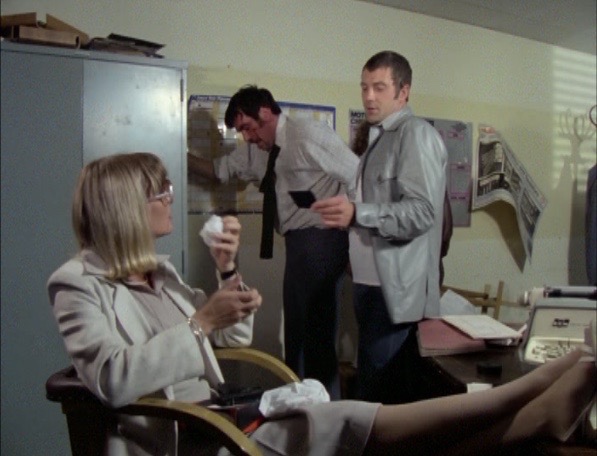
The stories haven’t changed a great deal either. CI5 battles spies and international criminals but their main focus is combating terrorism.
There’s enough action and mayhem to ensure that the viewer will overlook any deficiencies in the scripts. And for the most part the scripts are solid and tight.
The Professionals was intended as pure high-octane entertainment so don’t expect any philosophical musing or too much in the way of subtlety. On occasions the series does confront ethical issues but this is not Callan, or even Danger Man. If you’re looking for a series that offers provocative intellectual insights into the morality of espionage this is not that series. The Professionals offers car chases, gun battles and explosions.
But the action is handled with style and energy.
Episode Guide
The Purging of CI5 was a logical enough choice for a season opener, with lots of action, lots of explosions and lots of excitement. Someone is trying to destroy CI5. Their plan seems to be to kill every last CI5 agent, including Cowley. And they seem quite capable of doing so.
This episode is quite reminiscent of the excellent 1969 Callan episode Let's Kill Everybody. In fact the premise is more or less identical. It’s not a bad episode.
In Backtrack CI5 have to stop an arms smuggling operation. They have a witness who might be useful, if they can keep him alive. They have to follow the trail of evidence back to a burglary. That burglar found something crucial. Bodie and Dole have to try out their own skills as burglars.
A typical but very entertaining episode with Cowley being particularly ruthless.
Stopover starts with a British agent who has just escaped from the Khmer Rough. He has some interesting information about a high-level defector. Of course there are twists. A solid enough plot.
In this episode there’s plenty of focus on the tense relationship between Cowley on the one hand and Bodie and Doyle on the other. They feel that Cowley is concealing vital information from them, forcing them to work in the dark. And they’re right. And they resent it, understandably. One of the best episodes of the season.
Dead Reckoning starts with an exchange of agents by the British and the Bulgarians. The British got double-agent Stefan Batak as their part of the deal. The arrangement was that the deal was to be kept secret. There is a complication - Batak’s daughter Anna who lives in London. She was all set to go to Bulgaria to visit her father in prison.
There are the usual betrayals and counter-betrayals and complex plot twists. Cowley is getting plenty of information out of Batak. He thinks the information is accurate, but he still isn’t certain. And then disaster strikes. Could Anna be an assassin? Or is she an innocent pawn?
Doyle takes some film and somebody is very keen to take it away from him. The trouble is that the film doesn’t show anything that could possibly be useful.
A nicely cynical twisted spy thriller plot. A very good episode.
The Madness of Mickey Hamilton starts with an attempted political assassination but the viewer already has reason to suspect that something else is going on. CI5 however are sure it was an attempt to kill an African diplomat. If they’d realised earlier that were barking up the wrong tree disaster might have been averted, but that the theme of this episode - by the time anyone realises there’s a problem it’s too late.
A good episode with Doyle showing an unexpected touch of compassion. To everybody else the villain in this story is just a villain, but to Doyle’s he’s a victim.
A Hiding to Nothing involves the possibility of an assassination attempt on an Arab leader. And CI5 has a leak. There are lots of twists to come.
Again we see a subtle difference between Bodie and Doyle, with Doyle being just as tough but with more of a human side. Excellent episode.
In Runner a gun shop is robbed. Robbed of a variety of very nasty weaponry. CI5 assume it’s the prelude to a major campaign of violence, a campaign of political violence by an outfit referred to as the Organisation (presumably some offshoot of the IRA).
CI5 are being manipulated and Doyle is being manipulated. The Organisation is being manipulated. There’s a dangerous game being played, and the motivations are not clear. CI5 have to find out what those motivations are. They have a number of sources of possible information but those sources are not exactly friendly. A solid episode with a fiendishly complicated plot. Maybe too complicated. You’ll have to concentrate.
In the season finale Servant of Two Masters Bodie and Doyle have to investigate a possible traitor - George Cowley. This is by far the weakest episode of the season. You have to take seriously the idea that Cowley might be corrupt, and I don’t believe that a single viewer would have bought that for a second. If you don’t buy it the story becomes boringly predictable.
Final Thoughts
Overall a strong season with the season finale being the only dud episode. Other than that there’s plenty of excitement and mindless violence. Highly recommended.
Friday, 3 March 2023
The Avengers, four early Mrs Gale episodes
Steed would continue to evolve, gradually becoming a dandy with a love for vintage cars and the finer things of life. Interestingly enough he does not yet have his Bentley. In Traitor in Zebra he drives a very nice 1930s Lagonda.
He would also slowly become more obviously upper-class, more obviously a polished well-educated gentleman, albeit one with very few moral scruples.
Initially no-one was quite sure how Honor Blackman was to play Cathy Gale. The idea of having an expert in unarmed combat with a penchant for black leather emerged gradually during the first Cathy Gale season (May 1962 to March 1963).
The relationship between Steed and Mrs Gale was exceptionally interesting. She doesn’t really trust him completely, and with good reason. He manipulates her and he sometimes neglects to tell her things that she really is entitled to know.
The reason The Avengers lasted so long and became increasingly successful has a lot to do with the way the series was constantly evolving. The basic setup remained but the David Keel, Cathy Gale, Emma Peel and Tara King eras all have their own flavour. The differences between the Cathy Gale and Emma Peel eras will be startling to those who are only familiar with the Emma Peelers.
Traitor in Zebra
Traitor in Zebra was written by John Gilbert and aired in November 1962. There’s a security leak in a top-secret defence establishment, HMS Zebra, which deals with laser tracking systems. A young sub-lieutenant named Crane has been accused of espionage. Steed and Mrs Gale have the job of finding out if he’s really the traitor. Steed goes undercover as a naval psychiatrist and Mrs Gale as a research chemist.
The local village is a small tight-knit community and the circle of possible suspects is fairly small.
This is early Avengers so it’s a straightforward spy thriller plot without any elements of the surreal or the fantastic. There is some gadgetry but it’s all plausible technology. In fact the technical stuff basically makes sense.
The methods by which the secrets are passed is quite ingenious.
It’s always fun to see William Gaunt (later to star in The Champions). He plays another young officer who is keen to help clear the name of his friend Crane.
It builds to a very satisfying very tense finale in which Steed’s ruthlessness is very much in evidence.
There’s quite a high body count. At this stage The Avengers was still a fairly hard-edged spy series that portrayed espionage as a game in which nice people often get killed, and the good guys can’t afford to be too squeamish about using violence.
The problem with this episode is that John Gilbert’s script is a by-the-numbers spy story and all the plot twists can be seen coming. In fact the viewer more or less knows exactly what’s going on early on, although Steed and Mrs Gale obviously don’t. It’s a competent episode.
Intercrime
Intercrime was scripted by Terrance Dicks and Malcolm Hulke. It went to air in December 1962. A couple of safe-crackers are murdered on the job, or at least one is murdered and the other left for dead. The survivor, Palmer, provides Steed with the first clues to what’s going on. It’s already suspected that an international crime syndicate is operating in Britain. There’s been a string of major robberies and the MOs don’t fit with the habits of any known local criminals.
Palmer, in a semi-delirious state, lets slip some important information. A key operative in the crime syndicate, Hilda Stern, is about to arrive from Germany. She is arrested and is to be deported but Steed gets a brainwave. Why can’t Mrs Gale impersonate Hilda Stern and infiltrate the organisation. Mrs Gale is not happy about this idea at all but is pressured by Steed into agreeing (typical of the uneasy relationship between them in this season).
As you might expect Cathy’s fears that this was going to be an insanely dangerous idea prove to be well-founded.
The weakness of the script is that Intercrime is so ruthless that inevitably some of its employees are going to turn against it.
This is a solid enough episode with some decent tension (Cathy Gale really does get into a very sticky situation). The plot is routine but the idea of an international crime super-syndicate is a good one. And Intercrime really does seem like a formidable enemy.
It’s interesting to notice how feminine Cathy Gale looks. Skirts and very feminine hairdos. This was not yet the black leather-clad Cathy Gale. This is also a Mrs Gale who uses guns rather than judo to deal with bad guys.
Quite a good episode.
The Big Thinker
The Big Thinker was written by Martin Woodhouse and screened in December 1962. There are problems with a new experimental super-computer called Plato. The problems might be caused by sabotage.
Cathy inveigles her way into Plato’s domain by posing as an anthropologist hoping to use Plato to translate dead languages. Computer whizz-kid Dr Kearns is an obvious suspect. He’s brilliant but erratic, he chases women, he drinks and he gambles. All of which could make him susceptible to pressure to betray the project.
There are some really nice scenes in this one, especially when Cathy’s flat gets broken into. The gambling scene between Mrs Gale and Broster is also excellent.
What’s nice is that the computer is more than just a McGuffin. It plays a central role in the story and also becomes a character. The idea that Plato isn’t just a computer but in fact the whole complex is also rather nifty. It’s not very original but it’s made to work here. You get the impression that Martin Woodhouse has actually put a bit of thought into the computer angle.
Mrs Gale is still very feminine but she has picked up a few unarmed combat skills.
Anthony Booth is terrific as Dr Kearns. He very wisely doesn’t try to soften the character - Kearns is arrogant and obnoxious but he’s vastly entertaining and the fact that nobody likes him plays an important story in the story.
Warlock
Warlock was written by Doreen Montgomery and went to air in January 1963. This was the episode that was supposed to introduce Mrs Gale but the producers were not satisfied and ordered a lot of reshooting.
In this episode Steed and Mrs Gale tangle with black magic. A physicist suffers what appears to be a stroke, but it isn’t. He then disappears. Steed found him clutching a hex symbol.
International spies (headed by a sinister fellow called Markel) are using black magician Cosmo Gallion to induce scientists to part with vital secrets. Mrs Gale just happens to be an expert in psychic and occult phenomena.
What’s interesting is that Gallion and Markel have totally separate and mutually contradictory agendas. Markel wants a secret rocket fuel formula; Gallion wants occult power.
It ends with Gallion performing a black magic ritual at which it appears that he intends to sacrifice Mrs Gale. The ritual scene tries to be as sexy and you could get away with on British TV in 1963, with a blonde girl dancing in a very skimpy costume. Wearing nothing but very brief panties on her bottom half was pretty startling in 1963. The mixing of voodoo and black magic is amusing and adds some spice. Of course all the occult stuff is a hopeless mishmash worthy of the Sunday papers but this is television and it’s supposed to be silly fun.
You have to remember that in the 60s the British press was continually creating moral panics about witchcraft in modern England.
The relationship between Steed and Mrs Gale is not yet clearly defined. She seems to be very disapproving of Steed at this stage. Steed is very obviously hoping to seduce her.
A well-crafted very enjoyable episode.
Final Thoughts
Four pretty good episodes with Warlock being the best of them.


